Mostrando las entradas con la etiqueta PlayStation 2. Mostrar todas las entradas

sábado, 8 de enero de 2022

"Gran Turismo 4"

Gran Turismo 4 is a 2004 racing-video-game for the PlayStation 2, the fourth installment in the main Gran Turismo series and the sixth for the overall series. It was developed by Polyphony Digital and published by Sony Computer Entertainment and was released on December 28, 2004, in Japan and Hong Kong, February 22, 2005, in North America, and March 9, 2005, in Europe, and has since been re-issued under Sony's 'Greatest Hits' line.

Originally planned for a 2003 release, Gran Turismo 4 was delayed for over a year and a half by Polyphony Digital, and had its online mode removed. The game features over 700 cars from 80 manufacturers, from as early as the 1886 Daimler Motor Carriage, and as far into the future as concepts for 2022. The game also features 51 tracks, many of which are new or modified versions of old Gran Turismo tracks, with some notable real-world additions.

Gran Turismo 4 was well-received critically and a commercial success, becoming one of the highest-selling games of 2005, and the third best-selling game on the PlayStation 2. The Chinese, Japanese, and South Korean releases of the game were bundled with a 212-page driving guide and lessons on the physics of racing. A limited-edition, Gran Turismo 4 Online test version, was released in Japan in summer 2006. A PSP enhanced port entitled Gran Turismo Mobile was originally planned for development, but was later renamed to Gran Turismo, which was released October 1, 2009. The follow-up game, Gran Turismo 5, was released in 2010 for the PlayStation 3.

Players accumulate points by winning races in the normal first-person driving mode, called A-Spec mode. Each race event can yield up to a maximum of 200 A-Spec points. Generally, a win using a car with less of an advantage over the AI opponents is worth more points. Points can only be won once, so to win further points from a previously won event, it must be re-won using a car with less of an advantage over the AI. There are also the 34 Missions which can yield 250 points each. Despite this, A-Spec points are experience points, not money.

The new B-Spec mode puts players in the place of a racing crew chief: telling the driver how aggressively to drive, when to pass, and mandating pit stops (by monitoring tire wear and fuel level). The speed of the time in the race can be increased up to 3x, allowing for Endurance races to be completed in less time than would take in A-Spec mode. The 3x feature, however, must be turned on after every pit stop because it resets to normal time. The game manual says that the player may speed up B-Spec mode by up to 5x, but this is believed to be a typo. B-Spec points are given out for each race completed in B-Spec mode. This increases the skill level of the AI driver in the categories of vehicle skill, course skill, and battle skill. Players can thereby use B-Spec mode in harder races as the game progresses, but this mode cannot be used on wet, dirt, and snow courses.

Another new addition to the game is the Driving Missions, which are similar in experience to the license tests, but award successful completion with 250 A-Spec points and 1000 or more credits. Each mission takes place with a given car on a given track or section of track, and a given set of opponents. There are 4 sets of missions: The Pass, in which the driver must overtake an opponent within a certain distance; 3 Lap Battle, in which the driver must pass 5 opponents over the course of 3 laps; Slipstream Battle, in which the driver must overtake identical opponents by way of drafting; and 1 Lap Magic, in which the driver starts with a significant time penalty against much slower opponents and must overtake them all in the space of a single lap. Completing each set of missions earns the player a prize car. There are a total of 5 prize cars available to be won, they are the DMC DeLorean, Jay Leno Tank Car, Pagani Zonda Race Car, Toyota 7, and the Nissan R89C.

A new Photo Mode is included in the game, which allows the player to control a virtual camera, taking pictures of their cars on the track or at specific locations, including the Grand Canyon. This game is able to produce a selection of screenshots with variable compression rate (Normal/Fine/SuperFine) and size (up to 1280x960 72dpi), and the user can choose to save or print to a supported USB device.

Compared with Gran Turismo 3: A-Spec, graphics are greatly improved with more detail on cars and tracks (despite running on the same PlayStation 2 hardware). The physics are also greatly improved, with the major upgrade that cars now experience body movement, such as pitching (forwards and backward rolling) under braking. Barriers have considerably more friction to slow down the cars in GT4 (in an attempt to stop the use of "wall riding"), but there is minimal friction between cars, so the advantage obtained by running into the side of another car (instead of braking) is still present. Each of the Driving Missions and Special Conditions events give a 5-second penalty for hitting the walls or opponents' cars in this way, where the car's speed is restricted to 50 km/h (31 mph) until the timer disappears when it reaches zero.

The game features a futuristic concept car called the Nike One 2022, designed in collaboration with Nike.


sábado, 1 de enero de 2022

"Silent Hill: Shattered Memories"

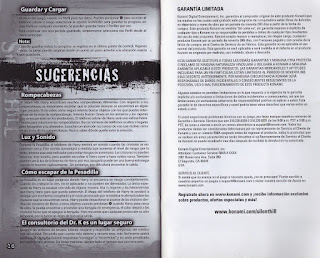
Silent Hill: Shattered Memories is a 2009 survival horror game developed by Climax Studios and published by Konami Digital Entertainment. It was released in December for the Wii and ported to the PlayStation 2 and PlayStation Portable platforms in January 2010. In April 2014, it appeared on the PlayStation Network in Europe.

Shattered Memories is a reimagination of the first game and retains the premise—Harry Mason's quest to find his missing daughter in the fictitious American town of Silent Hill—but is set in a different fictional universe, has a different plot, and altered characters, alongside new ones. Five endings are available. Gameplay takes place in two parts: a framing, first-person psychotherapy session, and an over-the-shoulder perspective of Harry's journey through Silent Hill, which is periodically interrupted by the occurrence of a shift to a more dangerous environment. Answers given to the psychological tests in the therapy session affect various gameplay elements in Harry's journey.

After designing the Silent Hill prequel (2007), which intentionally replicated elements of the first installment, Climax Studios wanted to try a different approach to creating a title in the series. Among the changes made was the removal of combat and the constant presence of monsters. Akira Yamaoka composed the soundtrack of the game, which was the first in the series to prominently feature dynamic music. The game received generally positive reviews for its graphics, plot, voice acting, soundtrack, and use of the Wii Remote were praised by reviewers, and has been favorably compared to M. Night Shyamalan's visuals. Though it drew mixed response for gameplay, puzzle exploration, chase sequences and psychological elements by some reviewers, which they respectively deemed potentially frustrating and short.

Silent Hill: Shattered Memories is a reimagining of the first installment of the series, Silent Hill. It keeps the premise of writer Harry Mason looking for his daughter in Silent Hill after a car crash, although it leads into a different plot. The personalities and roles of characters from the first game have also been changed, and Shattered Memories introduces new characters as well.

Silent Hill: Shattered Memories divides its gameplay between two different settings. The first section is set in a psychotherapist's office and the second in a town called Silent Hill. In the first section, the player interacts with Dr. Michael Kaufmann, a therapist who is a non-player character, from a first-person perspective. The player responds to Kaufmann's questions and completes a psychological test, fills in a questionnaire or colors pictures. The player's responses to these tests alters aspects of gameplay in the second setting, including the available areas, the physical appearance and behavior of characters encountered, and the physical appearance of the monsters. Shattered Memories returns to Kaufmann's office periodically throughout the game.

In the second setting, the player guides Harry Mason in an over-the-shoulder view as he searches for his missing daughter Cheryl in the snowy town of Silent Hill. Harry is equipped with a smartphone and flashlight: he can use the phone to check his location on a Global Positioning System map, take photographs, and make telephone calls. Moving to certain spots with high interference, represented by a lot of radio noise, or by taking pictures of spots where shadowy figures can be seen, unlock various text and voicemail messages that expand the story and occasionally provide clues. To view the details of various documents, the player can zoom in on objects. The game also alters details of gameplay based on what the player views. Throughout his journey, Harry encounters puzzles such as mechanisms, which reward either a key required to progress or a bonus memento. In the Wii version, the Wii Remote is used for puzzle solving and to control the flashlight and cell phone.

The game occasionally shifts to an icy alternate dimension called "Nightmare", where hostile monsters exist. To escape from this dimension, Harry must find a predetermined exit while avoiding the wandering creatures which chase him upon detection. Unlike previous installments in the series, there is no combat element to the gameplay: Harry is weaponless for the entire duration of the game and can only run, hide, slow down the monsters by knocking down objects to block their path, throw off the creatures if they latch onto him, and temporarily ward them off by picking up and using flares found lying on the ground. His running speed and "health" (the amount of damage that he can endure before dying) decrease every time the monsters grab him. In contrast to the previous installments of the series, which featured various types of monsters, Shattered Memories features only one type of humanoid monster, whose physical appearance changes in response to the player's actions inside and outside the Nightmare realm, including their responses to Kaufmann's psychological tests.

The game begins with a psychotherapy session conducted by Dr. Kaufmann, which acts as a frame story for Harry's quest. Suffering from issues with his memory, Harry travels home to search for his seven-year-old daughter Cheryl, hoping that she is already there. His consciousness moves between the in-game real world and Nightmare—a frozen version of the town in which monsters chase him—and finds that another family lives in his house. Police officer Cybil Bennett arrives and decides to take him to the police station, but they become caught in a blizzard, and Harry eventually leaves her car to continue his search. Eventually, Harry finds his way to the local high school, where he learns from a woman named Michelle Valdez that a Cheryl Mason attended school there previously, but then moved. She offers to drive Harry to Cheryl's new address, but after briefly stepping away, he returns to find Michelle has been replaced by Dahlia Mason, who claims to be Harry's lover and acts as if she has been with him the whole time. He accepts the ride, although during another shift to the Nightmare, the car falls into a river. Harry escapes but loses consciousness.

He awakens in a wheelchair pushed by Cybil in the town's hospital. Before Cybil can tell him about his file at the station, the town transitions to the Nightmare. Harry escapes and meets Lisa Garland, a nurse injured in a crash, and escorts her to her home. At her request, Harry gives Lisa pills for her headache, and returns to find her either dead or dying, depending on in-game actions taken by the player. Finding him next to Lisa's corpse, Cybil attempts to arrest him, but is frozen as the Nightmare emerges around them. Harry escapes to Cheryl's home, where he finds an older Dahlia who claims to be his wife and tells him that Cheryl is at the lighthouse. Harry enters the Nightmare, escapes it, and eventually gets a ride from Michelle. Harry finds a young-again Dahlia aboard a boat at a lakeside harbour, who sets the course for the lighthouse and seduces him. Harry wakes, finds an aged Dahlia and the environment covered in ice, and crosses the now-frozen lake but falls into the water and passes out. Harry is dragged ashore near the lighthouse by Cybil, who confronts him with the news that Harry Mason died eighteen years ago in a car accident. As Harry proceeds, he finds "the lighthouse" is the name of Dr. Kaufmann's counseling clinic: the patient in the therapy session is an adult Cheryl, who is in denial over her father's death. Harry enters the office and Cheryl either reconciles herself to his death or continues to cling to her fantasy father.

At the end of the game, an old video clip from Cheryl's camcorder is played. Four variations of this clip are available depending upon the player's actions as Harry. In "Love Lost", Harry packs his luggage in a car and tells Cheryl not to blame herself for her parents' separation. In "Drunk Dad", a drunken Harry yells at Cheryl, demands a beer and blames his drinking on his family. In "Sleaze and Sirens", Harry flirts on his bed with Lisa and Michelle. In "Wicked and Weak", Dahlia verbally abuses Harry and slaps him. In the "UFO" joke ending, Cheryl tells Dr. Kaufmann that she believes Harry was kidnapped by aliens and that Silent Hill is a spaceship. After James Sunderland interrupts, the therapy session continues, revealing Cheryl to be a dog and Dr. Kaufmann to be an alien. Regardless of the ending, the final scene shows Cheryl packing away mementos that the player can collect throughout the game. An additional scene the player can obtain shows her reconciling with Dahlia outside the clinic.

A playable demo of Shattered Memories was made available in June 2009 at the annual trade fair Electronic Entertainment Expo 2009 (E3) and received favorable reviews from video game journalists. A group of editors of the IGN website gave the game three "Best of E3" awards in the Wii category for best overall game, best adventure game, and best video game graphics technology. The game was also given a "Best Wii Game" award by editors of the GameSpot website in an article on their preferred games featured at the E3 show.

Shattered Memories was published by Konami for the Wii in North America on 8 December 2009; in Europe on 26 February 2010; and in Japan on 25 March. The Australian release was delayed until 22 June, due to European supply problems caused by the economic effects of the 2010 eruptions of Eyjafjallajökull. Major Australian retailers struggled to confirm available copies of the game for several months after the delayed release, potentially damaging initial sales of the game. The PlayStation 2 and PlayStation Portable versions were published in North America on 19 January 2010; in Europe on 26 February; in Japan on 25 March; and in Australia on 22 April 2010. It also became available on the PlayStation Network for Europe and the United Kingdom on 28 April 2014. A PlayStation Vita release for Shattered Memories was apparently planned, but was cancelled.


"MotorStorm: Arctic Edge"

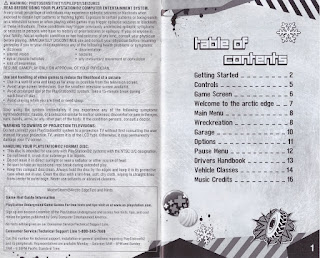
MotorStorm: Arctic Edge (released as MotorStorm: Raging Ice in Japan) is the third game in the MotorStorm series of video games, developed by Bigbig Studios and published by Sony Computer Entertainment for the PlayStation Portable and PlayStation 2, which was released in 2009.

The game once again moves away from the desert environments of the original title and the lush island environment of the sequel and relocates itself to the harsh Arctic climate of Alaska on the edge of the Arctic Circle. Gameplay is similar to that of previous titles in the series such as Nitrous Boosts, environmental hazards and destructible environments. Vehicles have the ability to cool down the boost by driving through deep snow or under waterfalls, the same technique used for driving through the water in MotorStorm: Pacific Rift. Unlike the previous titles in the series, the game only features a maximum of ten racers in each race.

New hazards include avalanches, which can be triggered by vehicle explosion or blowing the vehicle's horn, which causes a large amount of snow to rumble down the track and will strike away opponents, including the player, no matter the vehicles' strengths. Icy bridges can also be dangerous for heavy vehicles. While small vehicles can get over ice bridges, heavier vehicles can cause them to disintegrate and break, making the short-cut impossible to cross.

There are differences between PlayStation Portable and PlayStation 2 edition of the game in order to make use of each systems specific capabilities. The PlayStation Portable version features a Photo Mode, custom soundtracks and online play which features 6-player online multiplayer. On the other hand, the PlayStation 2 version features a split-screen multiplayer mode like the one present in the previous game, MotorStorm: Pacific Rift. The Time Attack game mode features an online leaderboard listing lap times set in the PlayStation Portable version of the game due to the PlayStation 2 version's lack of online functionality, though the mode itself is available for both consoles.

As with the previous MotorStorm title, the core game mode of MotorStorm: Arctic Edge is the Festival, where the player participates in over 100 events spanning across 8 tiers. These events include various race series called "Invitational".

The other gameplay mode of the game is known as the Wreckreation Mode, which consists of various game modes, such as:
  • Free Play, is the classic racing mode in most racing games where players select a race type, a track, and so on, followed by vehicle selection.
  • Time-Attack, is where players are timed as to how long they take to navigate through the curves and turns one lap at the time. Once the lap time is set, the ghost of the best recorded time by the player will appear on the course, though the player can instead opt to race against the ghost representing the time set by the developers.
MotorStorm: Arctic Edge features a total of 24 vehicles from 8 vehicle classes, most of which are specially designed to suit the Arctic climate: Bike, ATV, Snow Machine, Buggy, Rally Car, Snowplugger, Snow Cat and Big Rig. Each vehicle is fully customisable, with a vast number of cosmetic modifications, such as liveries, spoilers, exhaust, and sponsor stickers.

MotorStorm: Arctic Edge features a total of 12 tracks, alongside the reverse variants of each track. Some tracks also include numerous hazards within.

Icy bridges are seen during races in each track, and these will pose as a hazard for drivers below. While small, lightweight vehicles can easily navigate through, larger and heavier vehicles can easily disintegrate the bridge upon crossing it, thus causing opponents behind to tumble down the track, and will either be wrecked or receive some damage and drive off, if one of the heavy vehicles drives through while the other one behind falls down as the bridge gives way. Another new hazard, known as the avalanche, can be triggered by blowing the vehicles' horns, or by explosions from vehicles. The avalanche will then strike away opponents caught along the way. The amount of snow also increases as racers drive up the mountain, which would cause the surface to become more slippery for vehicles.

MotorStorm: Arctic Edge for the PlayStation Portable and PlayStation 2 was confirmed by Sony Computer Entertainment and was not developed by Evolution Studios who had previously developed the past two titles but instead by Bigbig Studios. Prior to that rumours of a PlayStation Portable edition of the previously PlayStation 3 MotorStorm had been swirling due to a tip by a staff member of Sony Computer Entertainment Europe in November 2008.

The game was met with positive reception. It has a score of 81% and 79 out of 100 for the PSP version, and 78% and 72 out of 100 for the PlayStation 2 version according to GameRankings and Metacritic.